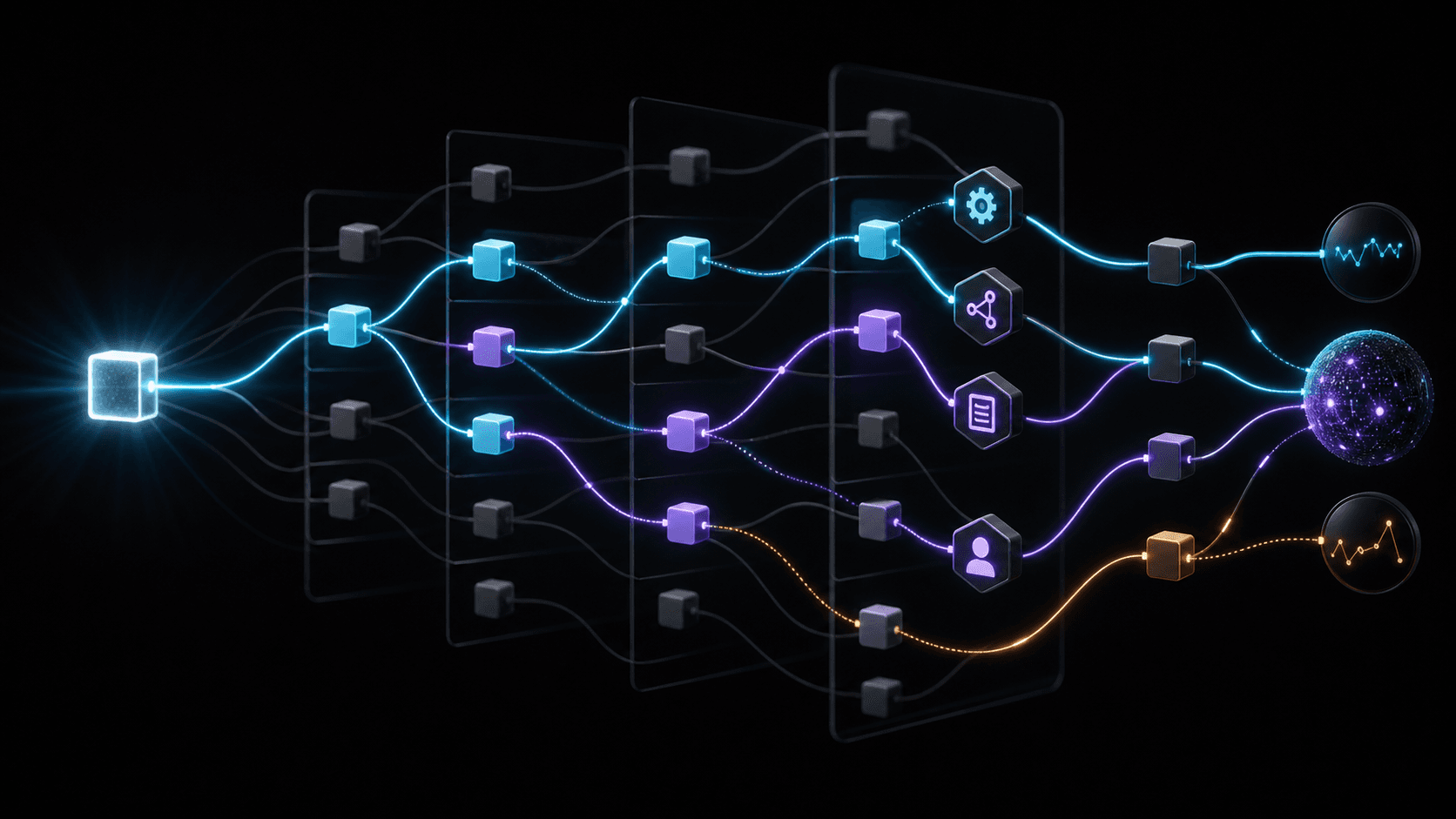
The phrase blast radius sounds dramatic. In practice, it answers a quiet question that appears in almost every meaningful review: If we change this, what else should we worry about?
Most tools answer by listing files with similar names, direct imports, or historical co-changes. Those signals help, but software impact rarely stops at the nearest file. A change can cross an API boundary, alter a queue contract, invalidate an operational assumption, or move risk into a service owned by another team.
Blast radius is not a list. It is a set of paths.
Why text search stops too early
Imagine a pull request changes token-validator.ts. Search can find references to that filename or symbol. It may miss that the validator protects a password-reset endpoint, the endpoint is called by the mobile client, a retry worker reuses the same token contract, and a previous incident led to a one-time-use requirement.
The useful path looks more like this:
token-validator.ts
  → DECLARES → validateResetToken
  → CALLED_BY → Password Reset API
  → CALLED_BY → Mobile Authentication
  → GOVERNED_BY → RFC-22
  → FIXED → Incident #91
  → COVERED_BY → reset-token.spec.ts
No single document contains the complete answer. The risk becomes visible when the relationships are assembled.
Five surfaces of change impact
A practical blast-radius analysis should consider more than code dependencies.
| Surface | What it reveals | Useful relationships |
|---|---|---|
| Structural | Imports, calls, schemas, routes | IMPORTS, CALLS, IMPLEMENTS |
| Behavioral | Requirements and tests | REQUIRES, VERIFIED_BY, COVERED_BY |
| Historical | Similar changes and regressions | CHANGED_IN, LED_TO, FIXED_BY |
| Organizational | Owners and experienced reviewers | OWNED_BY, REVIEWED_BY, HAS_EXPERTISE_IN |
| Operational | Deployments, incidents, alerts | DEPLOYED_TO, AFFECTED, TRIGGERED |
The strongest answer combines these surfaces without pretending they are equally certain.
Direct impact and plausible impact are different
If a changed module directly calls a payments API, the dependency is observable. If the same module often changes with checkout, that is a historical signal—not proof that checkout will break.
A trustworthy system labels the difference:
- Verified impact: supported by a direct code, configuration, or runtime relationship.
- Likely impact: supported by repeated history or a high-confidence inferred path.
- Knowledge gap: a critical path exists, but ownership, tests, or runtime evidence is missing.
This separation keeps a large graph from becoming a large confidence machine.
Rank paths by decision value
Not every downstream node belongs in a review. A popular utility can have thousands of consumers while only a few matter for the current change.
Rank paths using signals engineers can understand:
- directness: fewer hops generally deserve more attention;
- sensitivity: authentication, payments, migrations, and infrastructure increase consequence;
- evidence: direct observations outrank inferred co-change patterns;
- recency: current architecture usually outranks stale history;
- coverage: an affected path without tests deserves more scrutiny;
- ownership: cross-team impact increases coordination risk.
The output should explain why a path is ranked, not merely show a score.
Put blast radius inside the pull request
Engineers should not need to become graph analysts before merging code. A useful pull-request report can say:
This change modifies the session contract used by Authentication and Checkout. Authentication has direct integration coverage. Checkout has no test connected to the changed behavior. The last change on this path was reviewed by the Identity team after Incident #52.
That paragraph is compact because the graph did the hard work underneath. The reviewer can expand the affected paths, inspect the evidence, and invite the right owner.
Use uncertainty as a product signal
Sometimes the graph cannot establish impact. That is not a reason to generate a vague answer. It is a reason to create a knowledge gap:
- service boundary not established;
- owner not observed;
- API consumer unresolved;
- requirement lacks a supporting test;
- production signal is unavailable.
Those gaps tell the team where its software is hardest to understand. Closing one improves future reviews and future agent plans.
Blast radius should make the next action obvious
The goal is not to visualize the largest possible network. It is to help someone decide what to do before shipping.
A good blast-radius result ends with a short action set: run the missing contract test, request review from the affected owner, verify the migration path, or inspect the incident that established the current guardrail.
That is change intelligence: not “these things are related,” but this is the supported impact, this is what remains uncertain, and this is the next safest move.