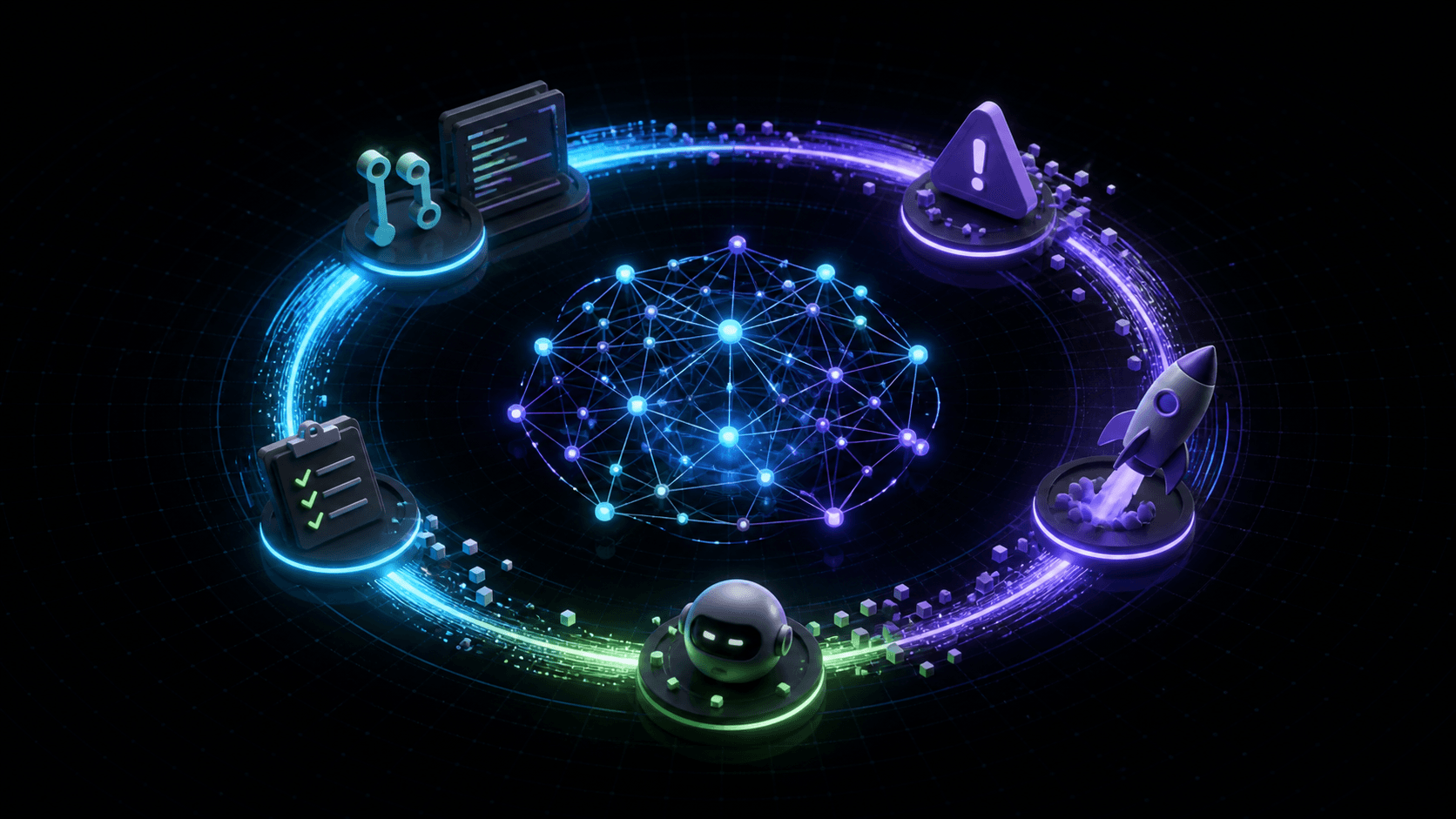
Most code intelligence products build a snapshot. They scan a repository, render a graph, and begin drifting out of date before the first user clicks a node.
Software is not a snapshot. It is a stream of changes, decisions, incidents, reviews, deployments, and corrections. An Engineering Graph becomes valuable when it operates continuously with that stream.
The product is the loop.
Observe, model, reason, act, verify, learn
A continuously operating graph can be organized as six stages:
- Observe: ingest repository, pull-request, incident, deployment, and agent events.
- Model: resolve identities and update typed nodes and relationships.
- Reason: construct intent-specific subgraphs and identify supported claims or gaps.
- Act: answer a question, comment on a pull request, route a review, or request evidence.
- Verify: compare claims with tests, human corrections, and production outcomes.
- Learn: update confidence, ranking, aliases, ownership, and gap priority.
Then the next event enters a better graph.
Treat every source as an event stream
GitHub webhooks are an obvious beginning: pull request opened, review submitted, push received, installation changed. The same event model can ingest CI results, deployment markers, incident updates, architecture decisions, and agent actions.
Normalize the envelope:
{
  "event_id": "github:delivery:abc123",
  "source": "github",
  "type": "pull_request.synchronize",
  "organization_id": "org_42",
  "repository_id": "repo_18",
  "observed_at": "2026-08-21T14:03:12Z",
  "payload_ref": "artifact://events/abc123"
}
Idempotent event IDs let the system retry safely. Source references preserve the evidence behind graph mutations.
Update incrementally
A new commit should not require a full repository rebuild. Reanalyze the changed files, then recompute relationships and derived signals for the affected neighborhood.
The graph itself helps define the work:
changed files
  → affected symbols
  → dependent modules
  → connected services
  → impacted derived claims
Incremental updates keep the graph fresh enough to participate in review rather than report on it later.
Turn uncertainty into a queue
Every failed query or incomplete review can create a structured knowledge gap:
- owner missing for a critical service;
- dependency supported only by stale evidence;
- requirement has no verifying test;
- incident fix is not connected to a production outcome;
- repository identity conflicts with an existing node.
Rank gaps by consequence and frequency. Some can be closed automatically during the next ingestion. Others can be presented to a human at a natural moment, such as review or onboarding.
Let corrections outrank extraction
Automated extractors will be wrong. The system must make correction cheap and durable.
When a user rejects an ownership edge or confirms a service boundary, store the correction as evidence with author, scope, and time. Future extraction should respect it until new contradictory evidence requires review.
This is how the graph becomes an organizational model instead of a recurring demo.
Connect predictions to outcomes
Before a merge, Helix may predict affected paths and risk. After deployment, observe what happened.
- Did the named tests pass?
- Was the change rolled back?
- Did an incident occur on an affected service?
- Did the suggested reviewer identify a missed path?
- Did the agent’s change satisfy the task?
Outcomes calibrate the system. They do not create perfect labels, but they expose where retrieval, graph structure, or risk reasoning failed.
Design the human loop into the interface
Continuous operation should not mean continuous interruption.
Surface the graph when it changes a decision: a newly discovered downstream service, a stale owner, an unsupported requirement, or a verified path that reduces concern. Let users inspect and correct the underlying evidence in one place.
The best graph is not the one with the most nodes. It is the one that gets more useful after every engineering event—and can explain exactly what it learned.